Of the Ultralong feedback mechanism is a feedback process in the human body that is particularly important for the hormonal balance. Such a self-regulating feedback is, for example, the interplay between the thyroid hormone and the thyrotropin (TSH) released by it. If this control loop is disturbed, diseases such as Graves' disease, an autoimmune defect of the thyroid gland, result.
What is the Ultralong Feedback Mechanism?
Thanks to the ultra-long feedback mechanism, the hormones control their own release. It is a physiological self-adjustment. The focus of this mechanism ‘is the hypothalamus. It is a crucial switching center in the human body and is located in the diencephalon. The hypothalamus keeps the body temperature constant and is the organizer of all reflexes of food intake. The emotional and sexual behavior is determined as well as the waking and sleeping rhythm.
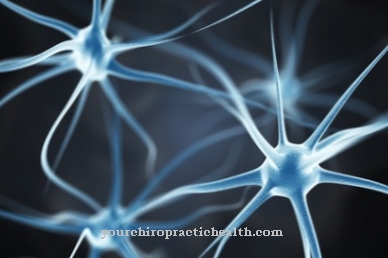
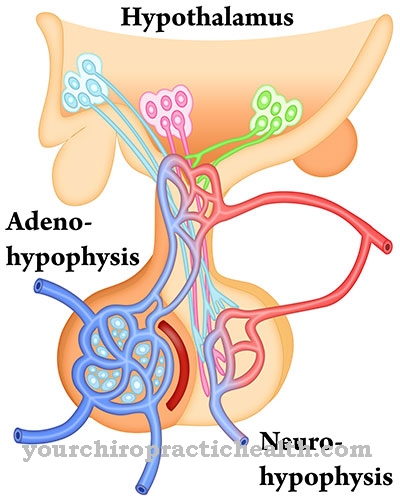
With regard to hormones, the hypothalamus regulates when and in what quantity a certain active ingredient is produced and released. For this purpose, special nerve cells of the hypothalamus are connected to the neighboring pituitary gland (pituitary gland), whose hormones in turn produce other hormones or supply them directly to the body's target organs.
All feedback is bundled in the hypothalamus, including the ultralong feedback mechanism and the ultrashort feedback mechanism. The differences between these two mechanisms lie in opposing levels of feedback. The long or ultralong feedback mechanism creates connections between the hypothalamus and the hormonal body periphery as well as information from the environment. Accordingly, the short or ultrashort feedback mechanism serves the relationships between the hypothalamus and the central nervous system.
Information about changes in hormone concentrations in the brain usually comes from the body's periphery. This data is passed on from the hypothalamus to the pituitary gland. This path is again an ultrashort feedback mechanism. The reaction of the hormone secretion from the pituitary gland then takes place via a long or ultra-long feedback mechanism.
Function & task
The ultralong feedback is one of several types of feedback and is also responsible, for example, for controlling the endocrine (hormone-producing) system. Its functioning therefore has a decisive effect on metabolic regulation, the water and electrolyte supply, growth processes, blood pressure and reproduction.
In this way, the entire human hormone balance is divided into long and short control loops. In this way, it is possible to react to the respective hormone requirements of the organism at any time and to organize the supply of the corresponding active ingredients. The focus is on the axis between the hypothalamus and the pituitary gland. All hormonal information is passed on through them.
Each control circuit is directly related to the other, so that the disruption of a single feedback mechanism inevitably leads to complications in the entire hormone balance. This is then reflected in impairment of body functions. Examples of this are an overactive or underactive thyroid. These symptoms are usually the result of an oversupply or deficiency of the hormone thyrotropin. This, in turn, is based on a specific malfunction of the pituitary gland. An excess of thyrotropin can also indicate a tumor in the thyroid gland. Even so, all hormone control circuits are sensitively disturbed.
The disease Graves' disease is also due to specific disorders in the control loops. This leads to an overactive thyroid, which is often associated with goiter formation in the thyroid area. Antibodies are increasingly produced by the body's immune system; the signal for this comes from the disturbed control loops. The thyroid reacts with increased activity and becomes larger due to the growth impulses.
The long and ultralong feedback mechanism carries these malformations on to the periphery of the body and causes various possible diseases. One example of this is what is known as Cushing's syndrome. There is a massive disruption of the hypothalamic-pituitary-adrenal cortex axis. Specifically, the blood sugar level may rise massively, which can lead to type 2 diabetes mellitus. Severe joint wear and muscle weakness may also be added. A so-called trunk obesity with the typical "bull neck" can also develop from it.
Illnesses & ailments
The ultralong feedback mechanism is part of the so-called thyrotropic control circuit between the hypothalamus, pituitary gland and thyroid gland. This influences the level of thyroid hormones in the blood plasma. The pituitary gland is responsible for the release of the hormone thyrotropin on this axis. Normally there is a balance between thyroid hormone and thyrotropin. This equilibrium is constantly monitored and, if necessary, regulated by the hypothalamus. To do this, it controls the production of both thyroid hormone and thyrotropin.
The benchmark for maintaining this balance is the ultra-long feedback mechanism. Its so-called autoregulation also levels the thyroid's iodine uptake. If the iodine concentration in the blood is too low, the absorption of iodine in the gastrointestinal tract and thus in the thyroid is automatically increased.
If the thyroid gland is under or overactive, the thyroid control circuit is always impaired. This can be due to diseases of the thyroid gland itself, but also to a tumor such as the pituitary gland. The thyroid can also suffer from hormone resistance, either naturally or through inappropriate use of medication.
Even changes in the remote periphery can have negative effects on thyroid function because they are inextricably linked by the ultralong feedback mechanism. In this case, harmful environmental influences, especially allergens and deficiencies in the metabolic cycle due to the feedback effect in the thyrotropic control circuit, can lead to serious diseases of the thyroid gland, which require a partial or complete removal of this [[organs, organ].








.jpg)


.jpg)