Under the Blood-urinary barrier the nephrologist understands a filtration barrier consisting of kidney corpuscles and Bowman's capsule. Due to the permselectivity of the barrier, blood proteins are not filtered out by the kidneys. With inflammatory processes in the kidney corpuscles, the blood-urinary barrier can be disturbed.
What is the blood-urine barrier?
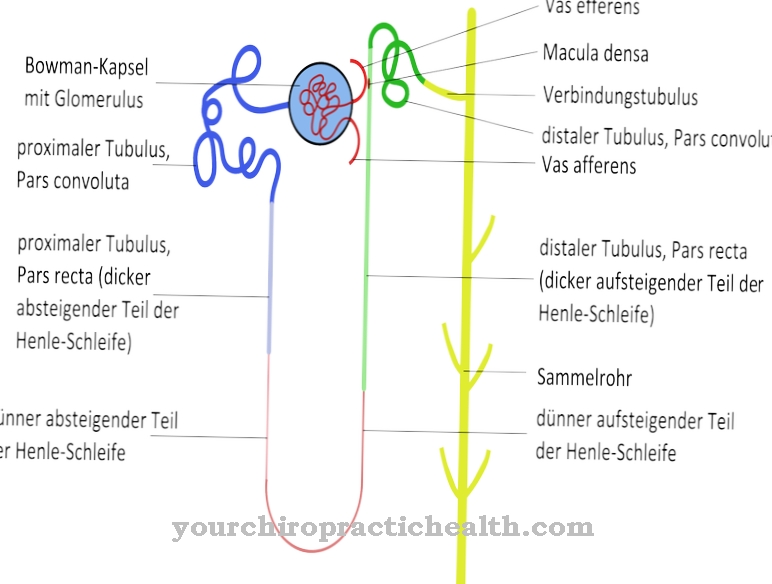
The blood-urine barrier is a three-layer filtration barrier. As a filter membrane, it mechanically removes particles from a suspension. The primary urine is filtered out as an ultrafiltrate from the blood in the blood vessel cluster. This filtering process takes place in the kidney corpuscles, which are enclosed in the so-called Bowman capsule.
The blood-urine barrier decides which molecules are filtered out. For this purpose, the anatomical system contains highly specialized structures. Around 120 milliliters are filtered through the blood-urine barrier per minute. Most of the filtered primary urine is reabsorbed in the tubules of the kidneys.
About 1.5 liters of urine are produced per day. The most important property of the blood-urine barrier is permselectivity. Only this permselectivity ensures that the kidneys only filter out harmful substances, while important proteins such as albumin are retained in the blood.
Anatomy & structure
The three layers of the blood-urinary barrier consist of the endothelial cells of the capillaries, the vascular coil of the basement membrane and the Bowman capsule. The first layer contains two selectivity filtering systems. Large molecular and negatively charged proteoglycans and glycosaminoglycans are located in the endothelial cells of the capillaries. In the intercellular spaces of the epithelial cells there are also pores with a diameter of 50 to 100 nm.
The mechanical filter barrier of the blood-urine barrier is formed by the vascular coil of the basement membrane. The tightly woven meshwork of this barrier is negatively charged and only permeable to molecules above 200 kDa. The cytoplasmic processes of the Bowman capsule limit the cell spaces to 25 nm. A proteinaceous slit diaphragm in the cell spaces reduces the pores to five nm. Thanks to the slit diaphragm, only molecules with a weight of 70 kDa can pass through this part of the blood-urine barrier exceed.
Function & tasks
The blood-urinary barrier is impermeable to blood cells, anionic molecules and macromolecules. This impermeability results from the pore size and the anionic charge. There is also talk of charge selectivity. The negative charges prevent negatively charged blood proteins from being filtered out in the blood plasma at a pH value of 7.4.
There is also a size selectivity for the filtering process of the kidney corpuscles. The individual layers of the blood-urine barrier are only permeable for molecules up to a radius of eight nanometers. This size selectivity, together with the charge selectivity, is also known as the permselectivity of the blood-urine barrier. Due to the permselectivity of the anatomical structure, the barrier hardly filters out components that are important for the body. For example, albumin is one of the most important plasma proteins. For this reason it should only be filtered out to a small extent. The protein has a weight of around 69 kDa and has an overall negative charge.
The radius of these molecules is about 3.5 nanometers. Therefore, it can only cross the blood-urine barrier to a small extent and remains in the body instead of being filtered out. For the filtering process, the difference between the pressure in the capillaries and the pressure in the Bowman capsules is all crucial. This pressure difference results from the colloid osmotic and hydrostatic pressure. While the kidney corpuscles are traversed by the blood vessels, the hydrostatic pressure remains at a certain level.
Because of the overall cross-section of the parallel capillaries, there is little resistance. The ultrafiltrate is pressed out in this way. Instead, the plasma proteins are left behind. This increases the concentration of proteins bit by bit as they pass through the capillaries. The colloid osmotic pressure increases with the protein concentration. The effective filter pressure drops as a result and reaches zero as soon as there is a filtration equilibrium.
Diseases
The most well-known disease associated with the blood-urinary barrier is glomerulonephritis. The glomerular capillaries are affected by inflammation in this phenomenon. As a result, the pores of the filter structure enlarge and the negative charge in all layers of the blood-urine barrier is lost. From now on, any macromolecules can pass the barrier.
The permselectivity of the anatomical structure is thus lost. Neither the radius of the molecules nor the charge properties are valid as filter criteria. Because of this, hematuria occurs. This means that patients notice blood in their urine. In addition, albuminuria can occur. Albumin is excreted in unnaturally large amounts in the urine. As a rule, this results in the nephrotic syndrome. The protein in the blood is decreased as part of this syndrome. The blood lipid levels increase and peripheral edema occurs.
Nephritic syndrome can also occur as a result of the symptoms described. In addition to pain on the flank, there is increased tissue tension. The kidney corpuscles can be permanently damaged by inflammatory processes and cause permanent renal insufficiency. Glomerulonephritis can develop as part of various primary diseases.
Tumor diseases are to be taken into account as well as autoimmune diseases or syphilis and HIV. The outbreak of glomerulonephritis can also be associated with the use of various medications. In addition to gold, for example, penicillamine can trigger the inflammatory reactions of the kidney corpuscles.
Typical & common urethral diseases
- Incontinence (urinary incontinence)
- Inflammation of the urethra (urethritis)
- Urethral cancer (less often)
- Urethral stricture
- Frequent urination





.jpg)